Oven-Dried Tomatoes

Tarts – Mixed Berry and Caramelized Banana

November 17, 2009 · Leave a Comment

Delicious tarts cobbled up with what I had in the pantry and fridge. The dough is a simple 3-2-1 (flour-butter-liquid) with egg yolks making up half of the liquid and ice water the rest. I also added some vanilla sugar for flavor and to help brown the baked pastry. I baked them blind till completely cooked and crispy/flaky. The filling is basic pastry cream made using the solid recipe from Dorie Greenspan’s book “Baking: From my Home to yours“. I love banana pies, Diana does not. So, hers was topped with a mixed berry sauce (frozen mixed berries cooked briefly with sugar and chilled). Mine was filled and topped with banana, sprinkled with sugar and caramelized with a torch then sprinkled with pistachios.

→ Leave a CommentCategories: Baking · Book Recipes · Food · Pastry

Pork Daube with Wild Mushrooms – The Terrine

November 16, 2009 · Leave a Comment

As I mentioned in the last sentence of my Pork Daube post, the leftovers are delicious. We ate it for a day or two afterwards, simply reheated, but with the gelatin rich sauce that this stew has, I wanted to try something else. I  separated the solids from the cooking liquid and chopped everything coarsely. I reduced the cooking liquid a bit more, tossed it back with the chopped solids and added a bit more seasoning. Since this will be served cold, a bit more salt is a good idea. I packed it in a terrine and refrigerated it till it gelled solid. Served with cornichons and good Pomery mustard this is elegant and delicious. Since I did not mince everything, the terrine did not slice perfectly, but I love the coarse texture I got by hand chopping.

Pork and Mushroom Daube Terrine

→ Leave a CommentCategories: Film Listings/Ratings

Le Cercle Rouge (Jean-Pierre Melville – 1970) A

November 14, 2009 · Leave a Comment

Crooks cross paths coincidentally and set off on executing a jewelry heist at a store in Paris’ Place Vendome. I specify Place Vendom because it is important, it is quintessentailly French and Parisienne and so is this film. The men wear trench coats and fedoras, meet at cabarets, smoke Gitanes, have piercing looks and never, ever smile. Crooks or cops, they live by their own code and honor (can you make a mob-connected cabaret owner an informant if it is not “in his nature”? Maybe, but it will not be easy). I love it all. I could not help but compare this to a dozen other modern caper flicks, Ocean’s 11 comes to mind. I had no doubt that Danny Ocean and his slick crew will accomplish their goal and get away with it. And that was fun. In Mellville’s movie, I was never sure Corey and his two-man team will get anywhere even close to the Jewelry shop. Planning? we hardly see any of that either. What we get are long stretches of dialogue free “action” where so  much is communicated between men who just “know” what needs to be done. We also get that engrossing noir mood which is after all what a good noir is all about. Le Cercle Rouge does not only deal with interesting crooks here but also a fantastic character in the form of Le Commissaire Mattei, the patient and cool cop on their tracks who happens to be the equivelant of “the cat lady” in the privacy of his own apartment. Such details fill the movie and are not really needed for any form of plot, they are there because they make for a richer character, a person with a life other than that of catching criminals.

→ Leave a CommentCategories: Film Listings/Ratings

Pork Daube with Wild Mushrooms

November 10, 2009 · Leave a Comment

Pork and Mushroom Daube 002

I get home Thursday evening from my business trip and start flipping through Paula Wolfert’s  “Mediterranean Clay Pot Cooking” to pick a recipe to try out. I quickly settled on the “Pork Daube with Wild Mushrooms“. It just sounded right and flavor profile was very attractive with lots of dried Porcini, white sweet wine, herbs,  juniper and of course pork. Daube refers to a number of Southern French stews, in my experience, usually the end result is not as wet as what we commonly think of as stew but is very intensely flavored due to long slow cooking and -usually- cooling the meat in the stew before cooking it again to reduce the juices and concentrate the flavors.

I started working on this Friday evening for a Sunday dinner. Sure, it needs some forethought, but most of the work is quick and most of the time spent is simply marinating the meat and gently simmering it. So, Friday night I marinated the pork shoulder in a mixture of Gewrztraminer, onions, carrots, a spice sachet that included juniper, lavender and pepper, and an herb bundle. That’s all for day one. Like many a French stew the next step involved draining the meat and reserving the marinade. The meat is then browned and transferred to a clay pot along with browned onions and carrots. Lining the clay pot are several pieces of fresh pork skin. The skin here will add tremendous body to the resulting stew due to it’s very high level of unctuous collagen. The reserved marinade is simmered with dried porcini soaking water to make a fragrant flavorful braising liquid (the house just smells heavenly due to the dried porcini – simply amazing stuff). After topping the meat in the pot with the braising liquid, the whole thing goes in the oven for a couple of hours, then it is cooled until the next day.

A few hours before dinner, I saute a bunch of cremini mushrooms  and toss them in with the meat. Then it goes back in the oven for a few more hours until dinner time. The end result is deeply flavored with what I think of as “winter forest flavors” (dried and fresh mushrooms, juniper, thyme, pork, wine). The cooking juices where rich and delicious and the meat amazing. I served this with nothing more than homebaked French bread.

Pork and Mushroom Daube 005

A couple of points to keep in mind if making this dish:

First, and this is true of any dish cooked in a clay pot probably, clay pots differ a lot in conductivity. I used a Colombian La Chamba pot not a Daubiere like Paula does. I ended up having to cook the dish a couple of extra hours at 250F to get to the proper tenderness. So plan accordingly and give yourself some more time than the recipe specifies.

Second, There is an error/omission in the recipe. The dried porcini, after being soaked, drained and chopped are never used. I confirmed with Paula that these need to go in the pan in step 6 along with the onions and carrots.

Like all stews or daubes, this is so much better the next day in more ways than one. More on that later.

→ Leave a CommentCategories: Food · Mushrooms · Pork

I am Published!

October 29, 2009 · Leave a Comment

Well, not exactly, as in my own book. However, I’m in the next best thing. One of my recipes made it into Paula Wolfert’s latest tome, “Mediterranean Clay Pot Cooking: Traditional and Modern Recipes to Savor and Share“. Paula also included a very thoughtful introduction to the recipe in her inimitable style. I first “met” Paula online via eGullet.org years ago. We never met in person, but we exchange emails frequently and spoke over the phone a few times. When Paula needed testers for the updated version of one of her books I was happy to help. A few years back -yes, she takes her time with the books and it is worth it- Paula mentioned that she is working in a book about clay pot cooking and she asked if I have any unique traditional Lebanese recipes that would benefit from cooking in a clay pot. Two recipes immediately came to mind, both, as far as I know, are not only unique to Lebanon, but unique to the northern part of the country where I come from.

The first recipe we talked about was that of “Makhloota“, a thick soup made with various legumes and grains. It is served warm or room temperature. The other recipe was “M’tabla“, a cold yogurt, wheat grain and corn soup. This one is very summery and is supposed to be served chilled as a side dish to grilled or fried items (like Kibbeh) or on it’s own for a filling snack. At first both recipes were supposed to make it into the book, but unfortunately the “Makhloota” did not due to space restrictions.

It really gives me much pleasure to see the simple recipe that my grandmother made and still does make it to the published work of an author such as Paula. When I told my grandmother and mom about it, they both got such a kick from it that it made waiting for years for the book to be published very much worth it. I promised I will be sending them a copy of the book as soon as I can.

I barely had the chance to read through Paula’s book due to my recent (and a bit hectic) work schedule, but it is jam packed with unique and fascinating recipes from around the mediterranean. I am hoping to get to some of these pretty soon. With Paula’s permission, here is the m’tabla recipe…a bit out of season now that we are getting into the fall months but still worth making. If you stop right before adding the yogurt, you’ll have “Amhi’ah“, a thick porridge best served piping hot and mixed with a generous pat of butter and some salt. Now that is fall food.

Speaking of testing recipes, here are links to books I tested recipes for:

The Cooking of Southwest France: Recipes from France’s Magnificent Rustic Cuisine by Paula Wolfert. An updated classic that needs no introduction really. The Cassoulet, Garbure, Straw Potato Cake stuffed with Braised Leeks recipes alone are more than worth the price of admission.

The New Portuguese Table: Exciting Flavors from Europe’s Western Coast by David Leite. A great selection of recipes from this much overlooked cuisine. Portuguese food is rich in flavors like paprika, chilies, cilantro, garlic and spice. David also gives a very useful tour of Portuguese cheeses, wine and pantry. I really cannot recommend this highly enough.

mtabla

Lebanese Summer Wheat and Dried Corn Soup with Yogurt

This terrific recipe comes from my friend Houston-based Elie Nassar, who grew up in a small village in Northern Lebanon and loves to talk about the “comfort food” of his childhood:
“My grandmother, Selwa, used to make this soup, called m’tabla, in summer,” Elie told me, “a cold version of the hot thick porridge called amhi’ah prepared in winter. She would thin the soup with plain yogurt and salt along with some ice cubes so the yogurt would not curdle when mixed with the hot cooked wheat. Thinned even more, we’d drink this soup out of tall glasses. It’s delicious with a sprinkling of fleur de sel.”

Preferred Clay Vessel:
A 4-quart earthenware or ceramic flameware casserole
If using an electric or ceramic stovetop, be sure to use a heat diffuser with the clay pot.

Serves 6

1 cup peeled  or hulled wheat, or grano
1/2 cup dried white or yellow corn
2 to 3 cups plain yogurt, as fresh and sweet as possible
1/2 to l cup ice water
Fleur de sel

1.    Place the wheat and corn in a sieve and rinse under cold running water. Soak in a bowl of water to cover overnight.
2.    Drain the wheat and corn and place in a 4-quart earthenware or ceramic casserole with plenty of fresh cold water to cover. Slowly bring to a boil, starting on low and raising the heat gradually. Reduce the heat and simmer for about 2 hours, or until the wheat is very soft and the corn is cooked through. Add more water if it gets too dry. By the end of the process, you should have a very thick porridge-like mixture.
3.  Let the mixture cool, then refrigerate. Do not mix the yogurt into the hot wheat-corn mixture, or it will curdle. When cold, dilute the yogurt with l cup ice cold water and stir that into the soup. Add enough additional ice water to attain a thick chowder-like consistency. Refrigerate and serve this soup very cold in a tall glass…with a pinch of fleur de sel.

→ Leave a CommentCategories: Book Recipes

Pork, Apples and Polenta Cakes

October 25, 2009 · 4 Comments

For one reason or another I had a bunch of apples at home. It seems whenever we go to the store we buy apples whether we have some in the crisper drawer or not. So, when I picked up a nice pork loin at a local Asian grocery store with a thick layer of fat and skin on it, it seemed like a no brainer. Pork and apples.

I sliced some apples and cooked them sous vide with some butter, star anise and a couple of cinnamon sticks in the bag. These cooked for about an hour at 85 C and were firm but fully cooked at the end. With half of these I made a barbeque sauce, based on the recipe at Tri2Cook’s recipe here. I subbed apples and apple cider vinegar for the blueberry and blueberry vinegar. Other than that the recipe was done as is. The end results was very nice and I still have some in the fridge to serve in a sandwich or with sausages. The other half of the apples was sauted in butter at the last minute and drizzled with Steen’s Cane syrup at the same time to give it a nice caramelized surface.

The Polenta cakes were made based on the recipe from “Seven Fires: Grilling the Argentine Way” by Frnacis Mallmann. They are flavored with Parmesan and fresh oregano. I chose to roll the cooked polenta in plastic wrap into a sausage shape and then slice them into rounds for a more elegant presentation. These were finished on the cast iron griddle on the grill. Crispy on the outside and soft inside. I could eat a whole recipe by myself.

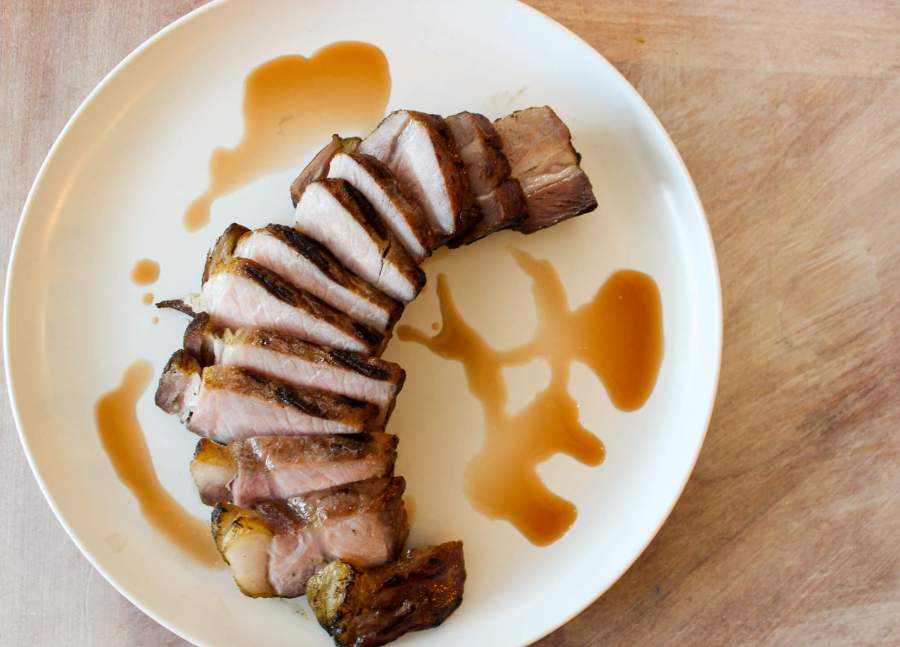
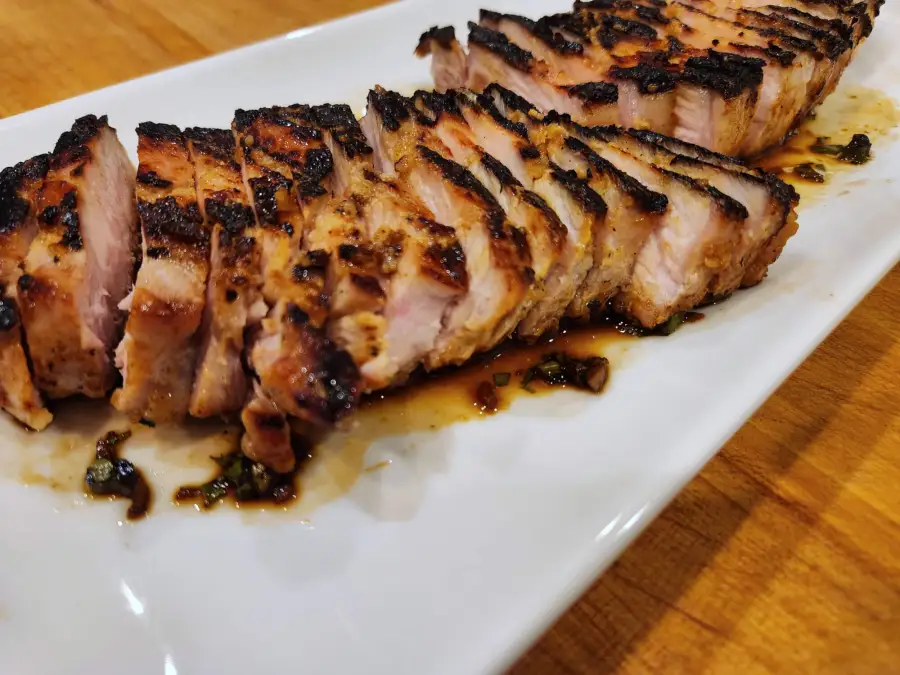
Continuing with the apple theme, I brined the pork loin in a mixture of apple juice with cinnamon sticks, salt and sugar. I then cooked it on the charcoal grill using indirect heat. In hindsight I think I should’ve removed the skin and simply left a layer of fat. In the time the loin cooked to rosy pink, the skin just does not cook down enough to turn soft and crisp. Instead it gets dark and hard. Other than that the pork was juicy and delicious with the brine flavor coming through. It also made excellent cold sandwiches for a day or two. As a last minute whim, I picked some Oxalis leaves and pods from my “garden” (really from my lawn) and used these tart weeds as garnish.

→ 4 CommentsCategories: Food · Pork

Paranormal Activity (Oren Peli – 2009) B+

October 20, 2009 · 1 Comment

Paranormal Activity, made for almost no money, is a very well crafted horror movie. It is very creepy, not as much while watching it in the theatre with a 100 other people. It’s creepy later, when you are home alone at 2 AM. I do have a problem with how dumb to the point of absurdity the character of Micah is! You’d think he would’ve gotten the point of “do not fuck with the demon” much earlier on. On the other hand the actor who plays the Psychic does a great job of delivering how serious the couple’s situation. Straight-faced and very subtle, he delivers an excellent believable performance.

→ 1 CommentCategories: Film Listings/Ratings

Pumpkin-Olive Oil Cake and Buckwheat Ice Cream

October 6, 2009 · 1 Comment

Every year I look forward to cooking with winter squashes in the fall. It really is a pleasure to go to the store and see all the different varieties of squash, from the large cool looking decorative ones to the smaller delicious butternut squash. A favorite fall dish of ours, and last night’s dinner, is ravioli or tortelloni filled with butternut squash puree. I wrote about it a while back here. Another popular use for these fall fruit (or is it a vegetable?) is in baking. I prepare waffles and pancakes with them, bake muffins, cheesecake and quick breads. For most of these baked goods, I use canned pumpkin. Along with canned beans and canned tomatoes, they are one of the few raw ingredients I do not mind using out of a can. Of course it depends on what I am doing, I’ll never make a creamy pumpkin/squash soup with canned pumpkin, but a cake like this one here is simply perfect made with a can of Libby’s pumpkin puree (NOT canned pumpkin pie filling!)

The buckwheat ice cream from the Alinea cookbook was the first thing that came to mind to accompany the cake. It is deliciously earthy, nutty and just screams autumn. The cake recipe is from Mario Batali’s “Babbo Cookbook“. It is made with olive oil, not butter, and is studded with bourbon-soaked raisins and pine nuts. The cake is fantastic with a mild spice flavor from both the spices and the peppery olive oil. It is also very tender, but holds it’s shape perfectly.

I intended to have a few more elements to this dish, but had no time for an elaborate sauce, and my Maltodextrin dry caramel just did not work out (too wet of a mixture is the cause I suspect). For plating, I had a square of the cake and a quenelle – a very ugly one at that- of the ice cream on opposite sides of the plate. I made a quick foamy sauce with olive oil, simple syrup, and a couple of tablespoons of cream and foamed it with a little Lecithin using a stick blender. I garnished the dish with drops of Steen’s Cane Syrup, bourbon raisins, toasted pinenuts and the olive oil foam. Steen’s, from Louisianna, is really a great ingredient and one of my favorite syrups. I bought my first bottle years ago because Emeril Lagasse kept on mentioning it and cooking with and I got curious. My pantry always has a bottle or two at all times now. I use it frequently on top of pancakes or waffles, as a topping for ice cream and in marinades or sauces. It tastes like a mild molasses with complex honey notes. Buy yourself a bottle if you see one at your store and give it a shot. This dish worked very nicely, I loved the flavors, the textures and – except for my ugly single spoon quenelle of ice cream (need to practice that technique)- looked lovely and warm.

→ 1 CommentCategories: Baking · Food · Ice Cream and Frozen Treats · Pastry